Compare AI Audio Tools
Side-by-side comparisons of the AI audio tools most creators actually use together—cleanup, enhancement, transcription, voice cloning, and podcast workflows.
Core Editing & Cleanup
Start here if you record podcasts, interviews, or voiceovers. These tools handle the heavy lifting: text-based editing, noise cleanup, and final loudness.
Descript vs Adobe Podcast Enhance
Use Descript as your main editor and Adobe Podcast Enhance as a cleanup stage. They’re complementary, not direct replacements.
Full editor
Descript
Text-based editing, multitrack timelines, and overdub for podcasts and YouTube.
- Best for: Podcasts, YouTube, screen recordings
- Key strength: Cut, move, and clean audio by editing text
- Watch out for: Short learning curve for new editors
Voice cleanup
Adobe Podcast Enhance
One-click noise and echo removal that makes rough recordings sound studio-like.
- Best for: Noisy rooms, remote calls, bad mics
- Key strength: Fast, dramatic cleanup in a single pass
- Watch out for: Can sound over-processed if pushed too hard
Adobe Podcast Enhance vs Auphonic
Think of Enhance as the fixer for ugly audio and Auphonic as the mastering stage that makes everything consistent.
Adobe Podcast Enhance
- Role: Cleanup bad recordings up front
- Best when: Background noise or room echo is obvious
- Use before: Auphonic or your mastering chain
Auphonic
- Role: Level, normalize, and gently clean final audio
- Best when: You want consistent loudness across episodes
- Use after: Editing and any heavy cleanup
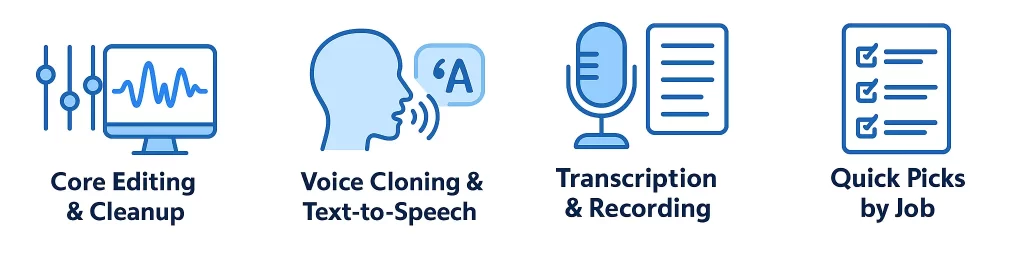
Voice Cloning & Text-to-Speech
These tools turn scripts into natural-sounding voices or clone real speakers for intros, ads, and narration.
ElevenLabs vs Play.ht
ElevenLabs
- Best for: Ultra-natural English narration and cloned hosts
- Key strength: Realistic prosody and low latency
- Ideal use: Podcast inserts, YouTube voiceovers, training content
Play.ht
- Best for: Character voices and multilingual projects
- Key strength: Large library across many languages
- Ideal use: Audiobooks, global content, character-driven audio
Transcription & Recording
Choose between maximum control with offline transcription or a simpler “record in the browser” workflow for guests.
Whisper vs Riverside
Whisper
- Best for: Accuracy, control, and multilingual work
- Key strength: Excellent transcription in many languages
- Trade-off: Requires setup and a separate editor
Riverside
- Best for: Remote interviews with non-technical guests
- Key strength: Cloud recording + automatic transcripts
- Trade-off: You’re tied to their recording platform
Quick Picks by Job
If you just want a starting stack, use these pairings and refine from there.
- Clean up rough audio fast: Adobe Podcast Enhance → Auphonic
- Edit podcasts quickly: Descript → Auphonic for final loudness
- Clone realistic voices: ElevenLabs (Play.ht for multilingual focus)
- Transcribe interviews: Whisper for control, Riverside for simplicity
Prefer full breakdowns instead of quick picks? Browse all detailed comparison posts below.